Most candidates tell you what they managed. This is what I built, ran, and scaled: an AI governance standard, two AI-native agent platforms, a three-product marketplace business, a turnaround, and a 21-to-150 location scale-up.
Eight operations. For each: what the problem actually was, what I built, and what it returned — in the numbers the business runs on.
01AIQA Global · Vice President of Strategy & Scale
Building the revenue engine for the company standardizing AI governance
Credit ratings made debt investable. Patent indices made intellectual property investable. Enterprise AI has no such instrument — no accepted, quantitative way to say how well a company governs the systems it is betting on. AIQA Global was founded to build it, by the team behind the NYSE-listed Ocean Tomo 300® Patent Index. I own the commercial side of that: the revenue strategy, the sales organization, and the platforms it runs on.
The gap
Enterprise AI is scaling faster than anyone’s ability to measure how well it is governed. Boards, investors, insurers and the enterprises themselves are all asked to trust systems nobody can score.
What the firm is building
An independent, quantitative rating for enterprise AI governance, and the market infrastructure around it. The firm publishes the Chicago Principles for Independent AI Assurance and holds itself to them — a check you control is not a check.
What I own
The entire revenue ecosystem: commercial strategy, the sales organization and its structure, pricing and packaging across every engagement tier, and the revenue lines beyond the core rating.
The AIQ™ Score · 250 data points, five weighted dimensions, a 0–200 scale
Oversight & accountability30%
Technical robustness25%
Strategic alignment20%
Responsible AI & compliance15%
Adaptability & education10%
Mapped against NIST AI RMF · ISO/IEC 42001 · OECD AI Principles · EU AI Act · GDPR
The platforms I built
The CRM
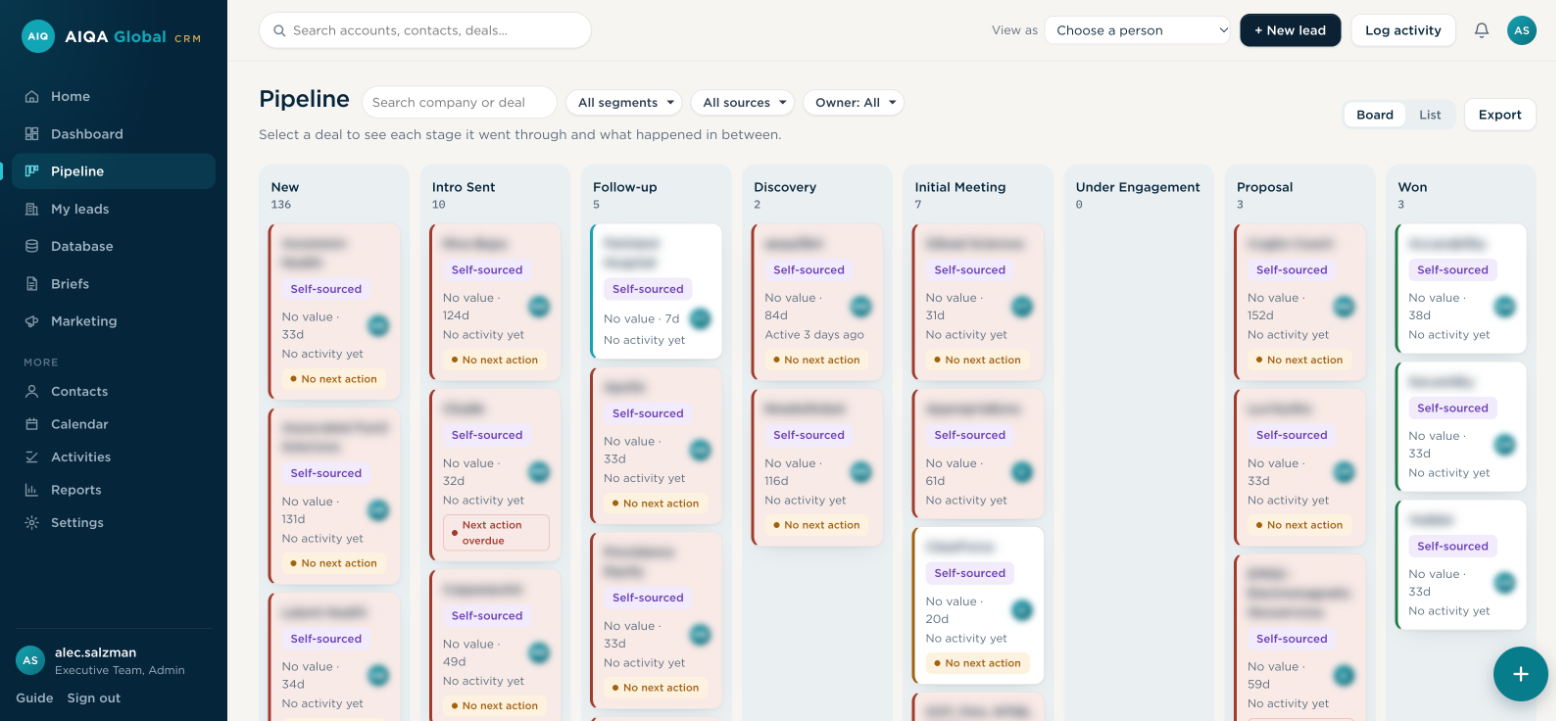
The sales system of record — React and TypeScript over PostgreSQL on Cloud Run. Every business rule lives in the database, so stage gates and atomic lead claims are enforced rather than suggested.
The Learning Center
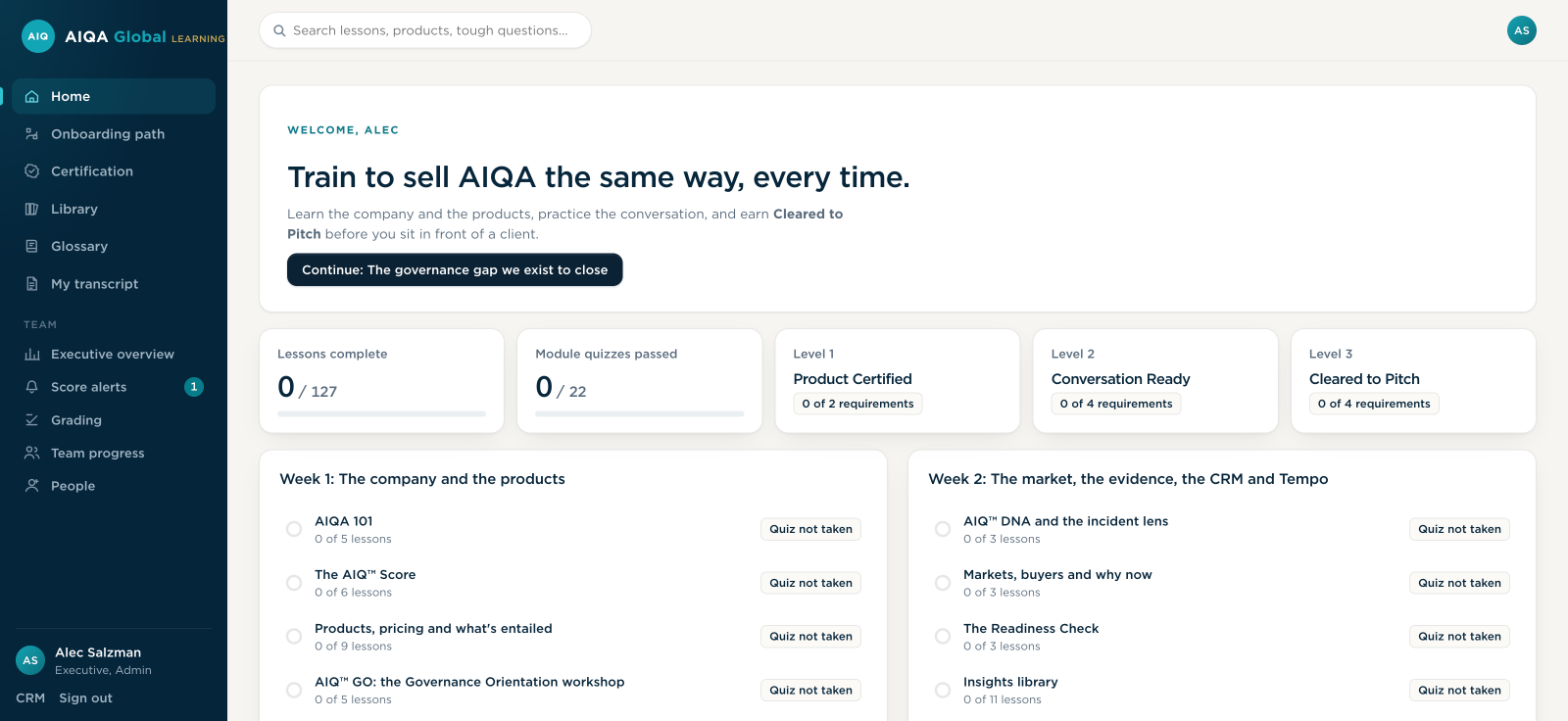
Onboarding and the Cleared to Pitch certification: twenty-two modules, three graded levels, scored server-side. Nobody speaks to a client until they have passed a live pitch to two certifiers.
The CRM · ten-stage pipeline with database-enforced stage gates (account names blurred)The Learning Center · 127 lessons, 22 graded modules, three levels to Cleared to Pitch
Inside the CRM
Role-based access for executives, market segment leaders, territory managers and stakeholders, on passwordless identity
A prospect database of 1,907 contacts across 825 companies, on an idempotent weekly refresh
A ten-stage pipeline with weighted forecasting and required fields enforced at the database layer
Product-level deal construction carrying negotiated discounts through to weighted value
Pre-call briefs routed to the executive team for feedback before the call happens
Prorated weekly activity targets, scheduled recap emails, and a live coverage dashboard
Inside the Learning Center
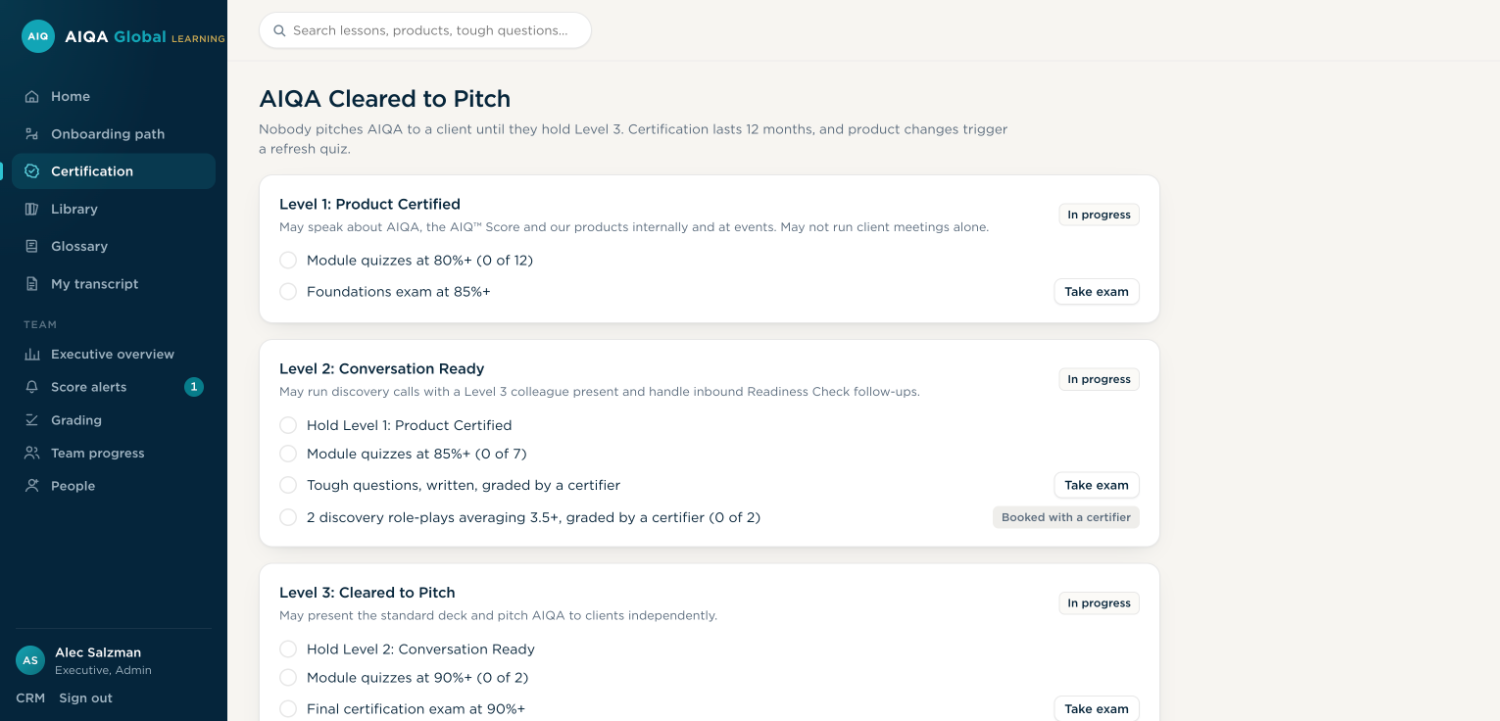
Level one: product knowledge at 80%, plus a foundations exam at 85%
Level two: 85%, a written tough-questions exam, and two graded discovery role-plays
Level three: 90%, a final exam, and a live pitch to two certifiers
Role-plays scored against a fixed rubric — opening, question quality, listening, stakeholder mapping, the bridge to AIQA, and voice
Grading runs on the server against shared rules, so a score cannot be argued with
Executives see the certification funnel, score alerts, and the questions people miss most
Cleared to Pitch · three levels, certifier-graded role-plays and a live pitch
250
Data points behind a single score
0–200
The scale, from nascent to leading
22
Modules before anyone is cleared to pitch
12
Market segments covered
02UsedLotData
A vehicle business intelligence ecosystem for real-time dealer decisions
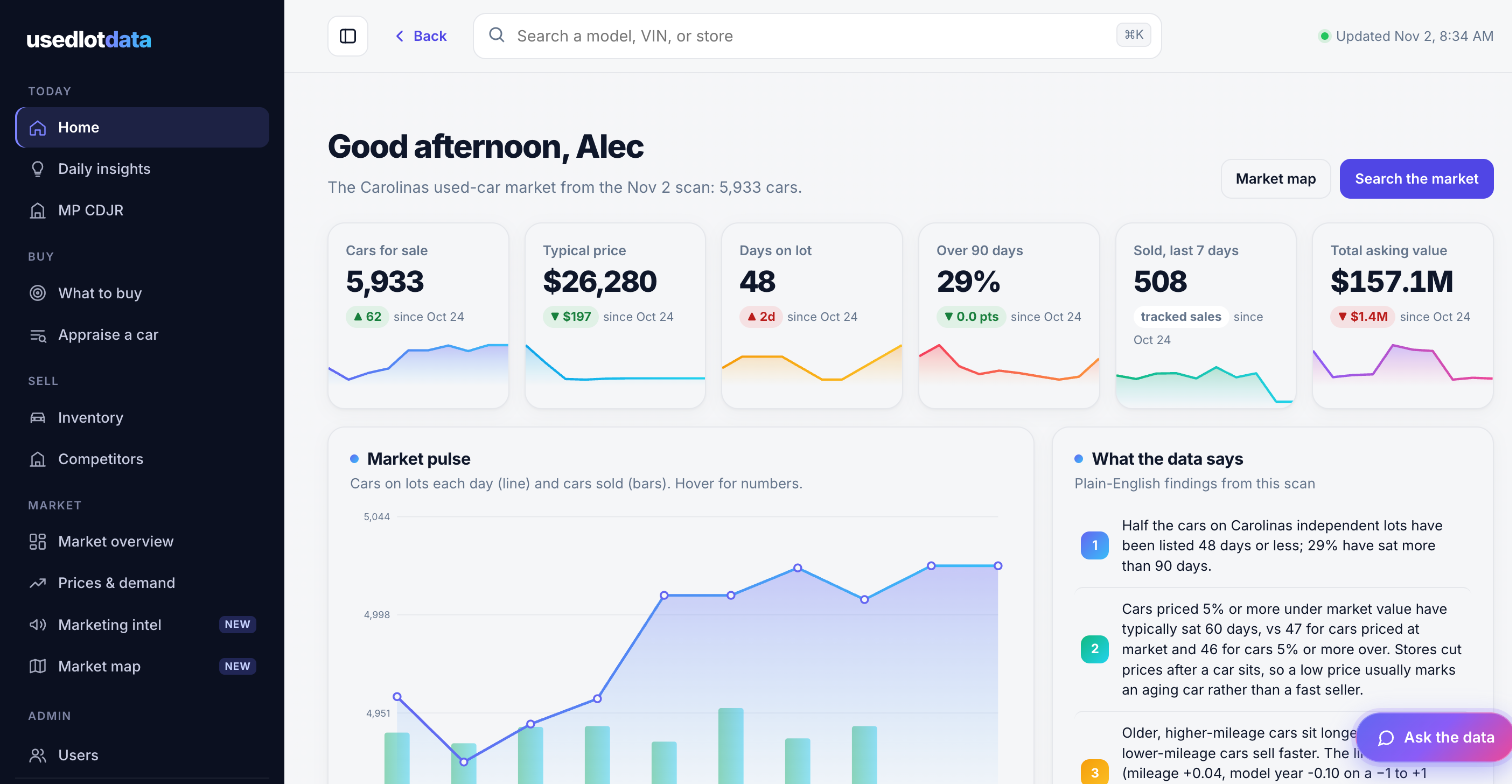
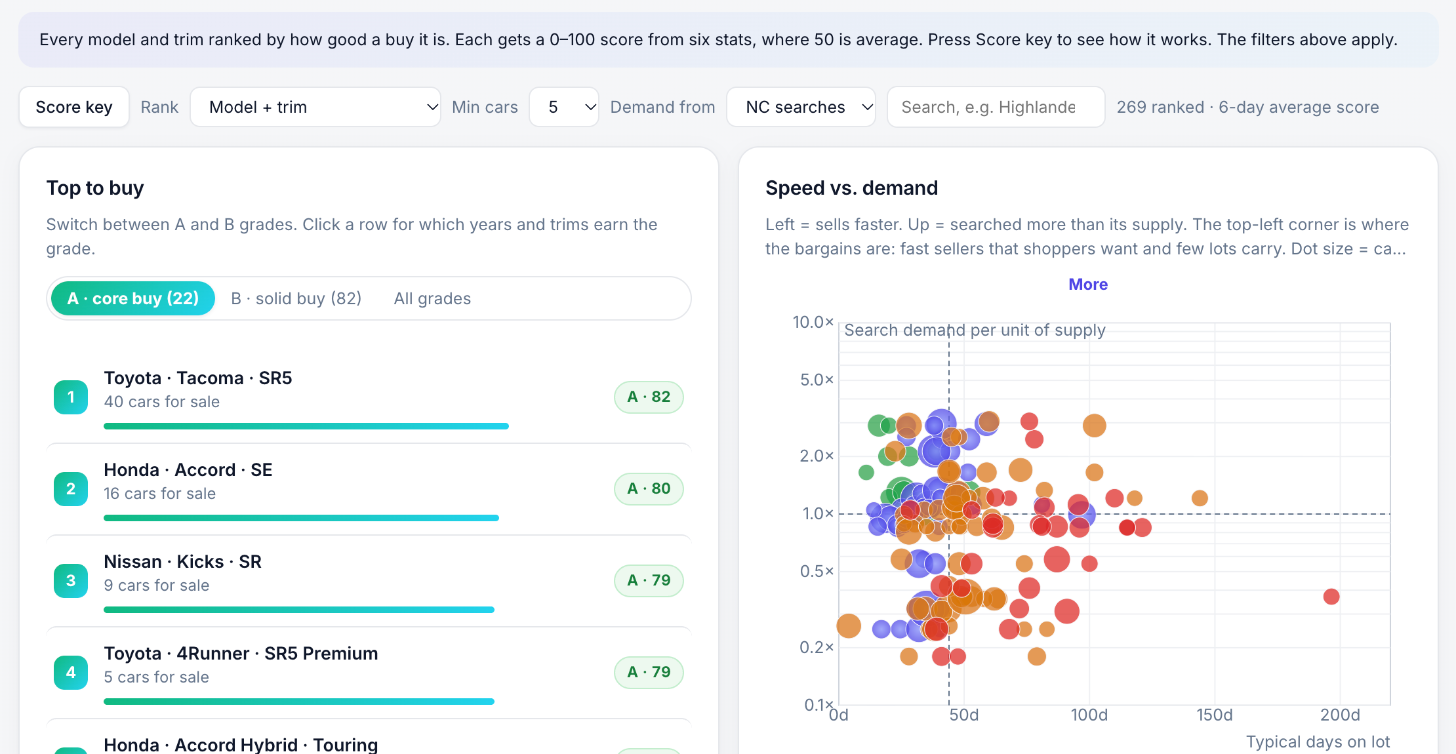
Dealers run seven- and eight-figure inventory on gut feel, last month’s auction report, and whatever the store down the road is listing. By the time the numbers show up in a monthly report, the money is already spent. I built a vehicle business intelligence ecosystem to change the foundation those decisions sit on: a live read of the market, every vehicle tracked from the day it lists to the day it sells, so a buyer, a GM, or a lender decides what to buy, what to pay, and when to cut price on what is happening today.
Real time
The whole market re-read every morning, before the first buyer is at their desk
Vehicle level
Every VIN followed from first listing to sale, price cut by price cut
Market + macro
Shopper demand, market value and the economy in one view
Decision-ready
Scores, rankings and an AI analyst instead of spreadsheets
Vehicle Business Intelligence Ecosystem · live market command view, refreshed every morning
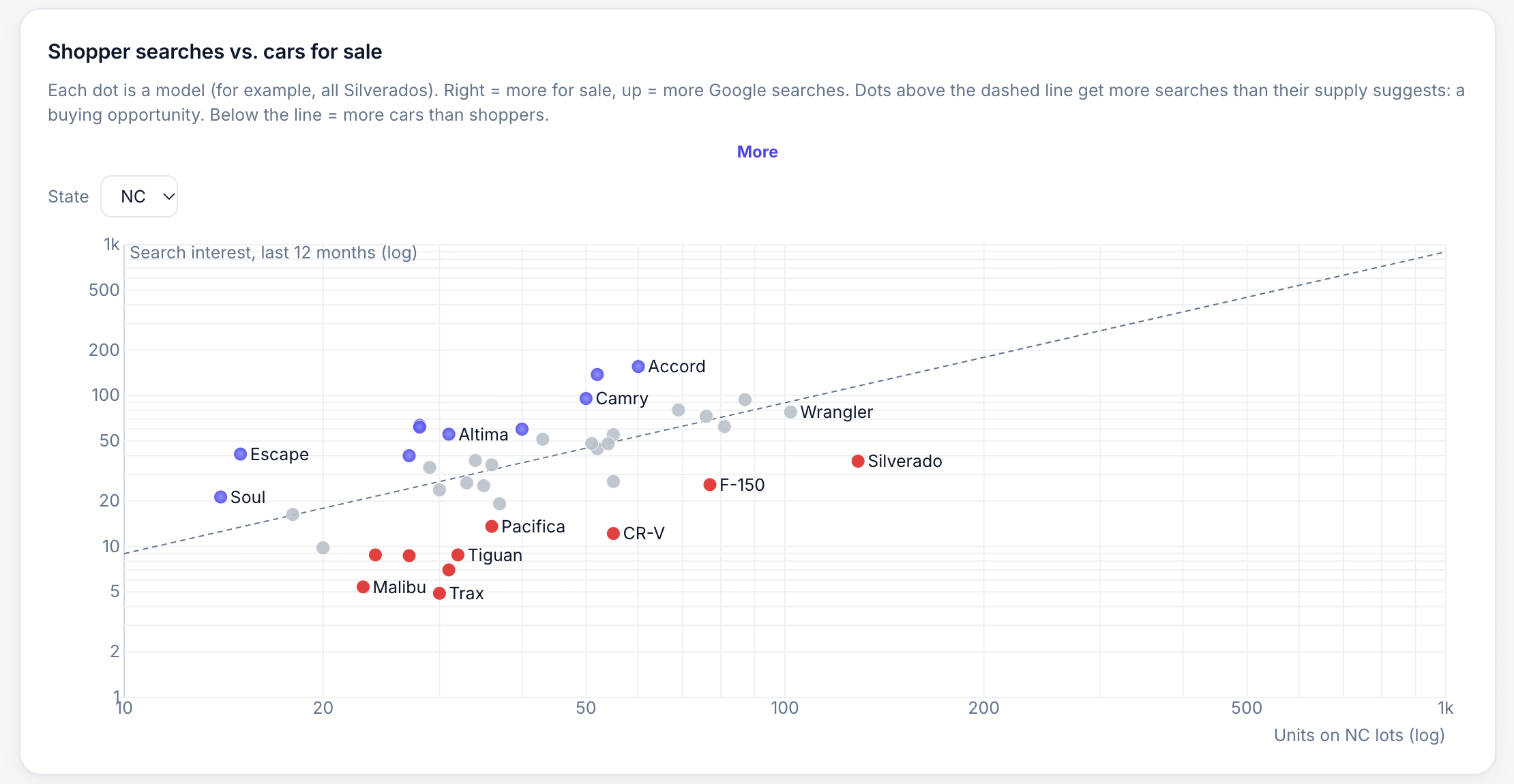
Buy rankings · every model and trim scored 0–100Demand vs. supply · shopper searches against cars on lots
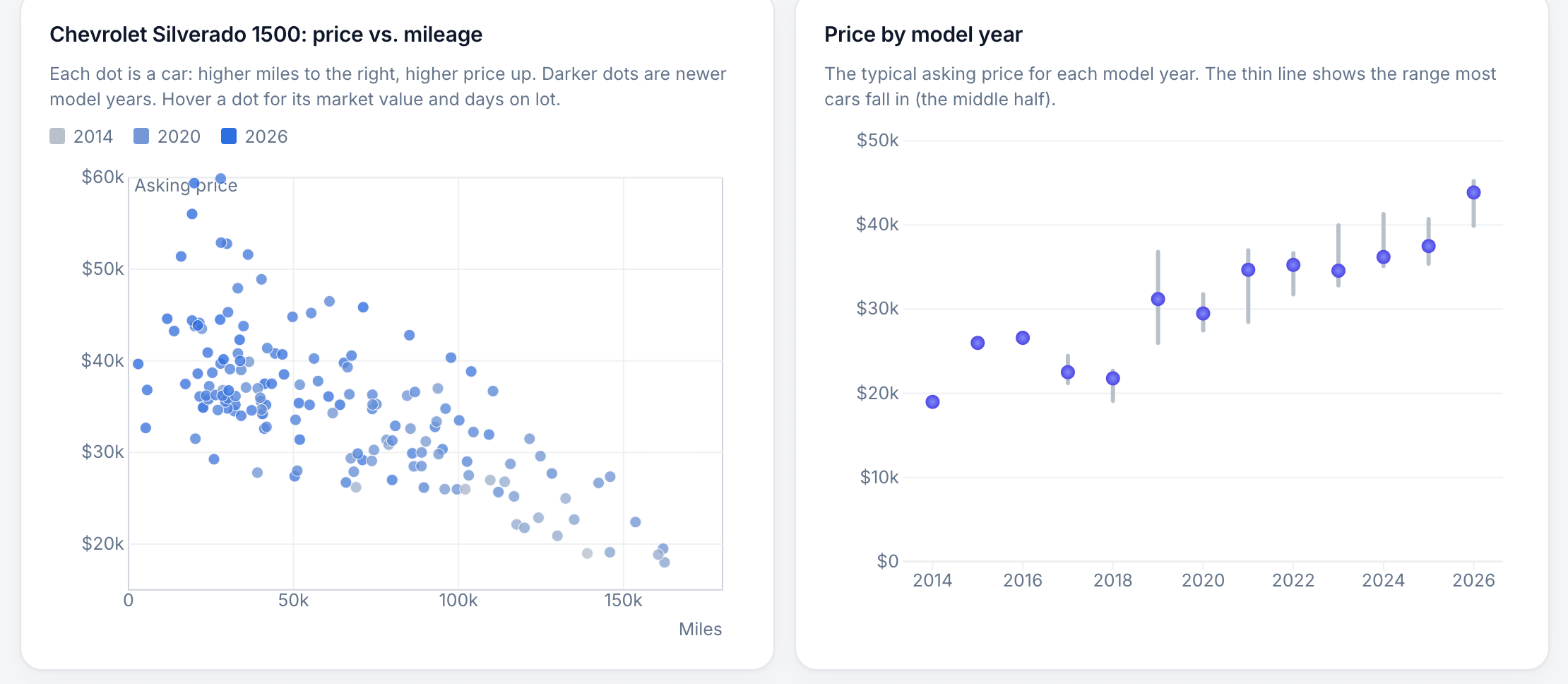
Pricing intelligence · every listing plotted, value curves by mileage and model year
Inventory & Turn
Every VIN followed from first listing to sale. Days on lot, aged-unit exposure, and sell-through by make, model, trim, and price band.
Pricing Intelligence
Each car scored against market value, with every price cut logged. Shows which discounts move metal and which just mark an aging unit.
Value Model
Depreciation per model year and the dollar cost of every 1,000 miles, model by model. Tells a buyer what to pay before the auction.
Demand Signals
Five years of consumer search by state and media market, set against live supply to flag under- and over-stocked models.
Market Conditions
Used-vehicle CPI, auto-loan rates, fuel, consumer sentiment, and state unemployment, pulled daily so the micro sits inside the macro.
Competitive Watch
Any competitor's lot on a daily watchlist: new arrivals, price moves, and what sold, without anyone refreshing a website.
The system underneath
A scheduled collection engine with adapters for the major dealer-website platforms, VIN decoding against NHTSA, and market-value data merged onto the same vehicles. Federal Reserve economic series and Google Trends feed in alongside. A daily build compiles around twenty analytical datasets that power the dashboard, and an “Ask the data” AI analyst answers questions in plain English straight from them. It runs unattended every morning, and every collector honors each site's published access rules.
What it surfaces
Findings no one in the market was looking at. The same truck or SUV can turn in half the time one state over. Cars priced well under market have usually sat longer, not sold faster. EVs and hybrids now sell faster than gas cars, and searches for used hybrids are up more than 70% in a year. That is the difference between guessing and knowing what to buy, where, and at what price.
03SellMyRide · COO & CPO
SMRx: an AI acquisition engine that answers every lead in under 60 seconds
Dealers do not lose vehicle-acquisition leads on price. They lose them on speed. Industry first response runs near 47 hours, roughly 78% of sellers go with whichever dealer reaches them first, and over half of inbound leads are never called at all. I sized it as a capacity problem, not an effort problem — 3,500 call attempts required each month against 1,320 a staffed team can actually place — then built the product, the pricing, and the operating model that closes the gap without headcount.
The capacity gap
A rep places about 60 calls a day. Day one of a 500-lead month demands 70 before a single follow-up cadence begins. Ten leads go untouched on day one and the backlog compounds — understaffed by two reps, $110k+/yr to hire the gap away.
What I built
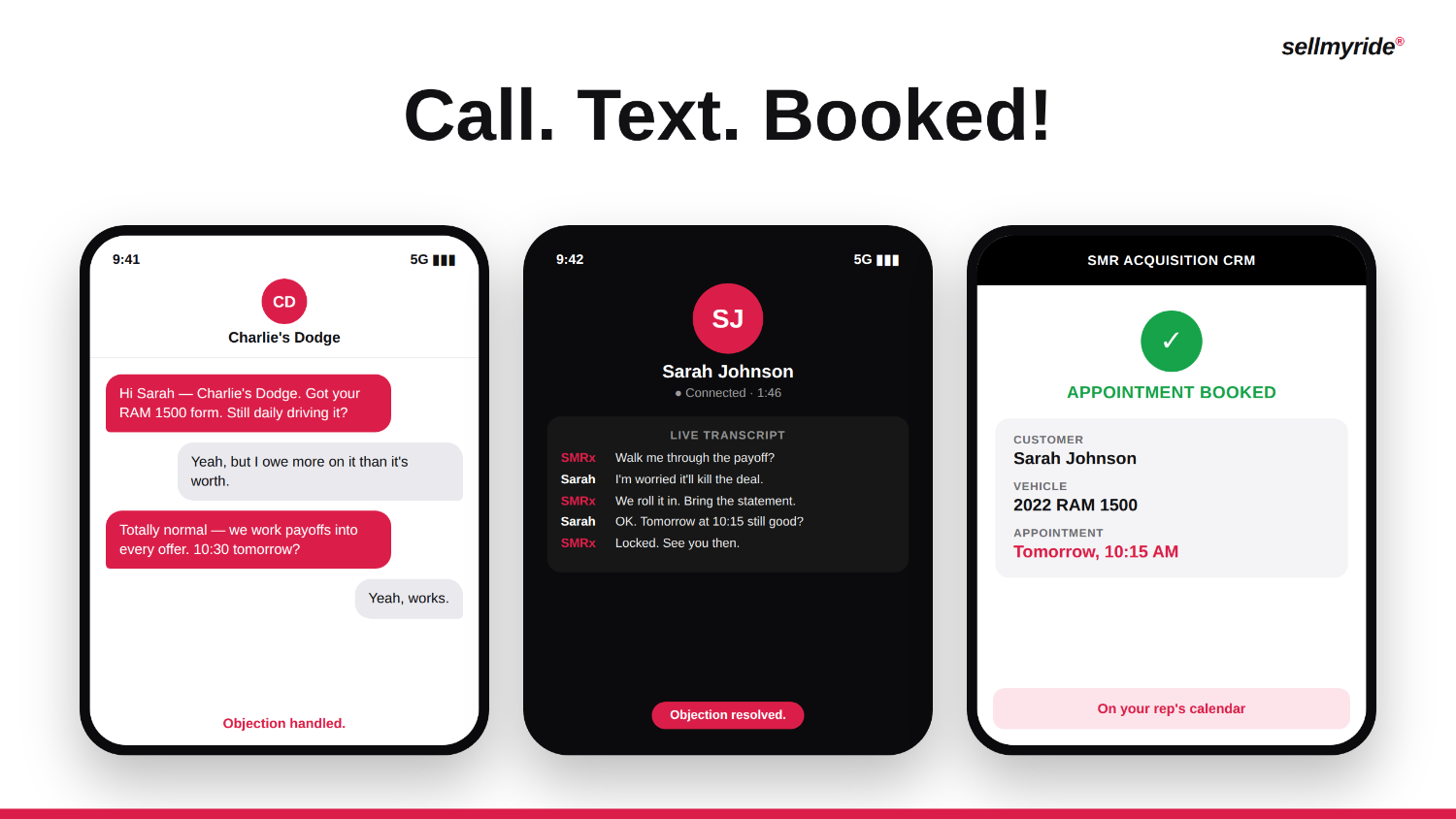
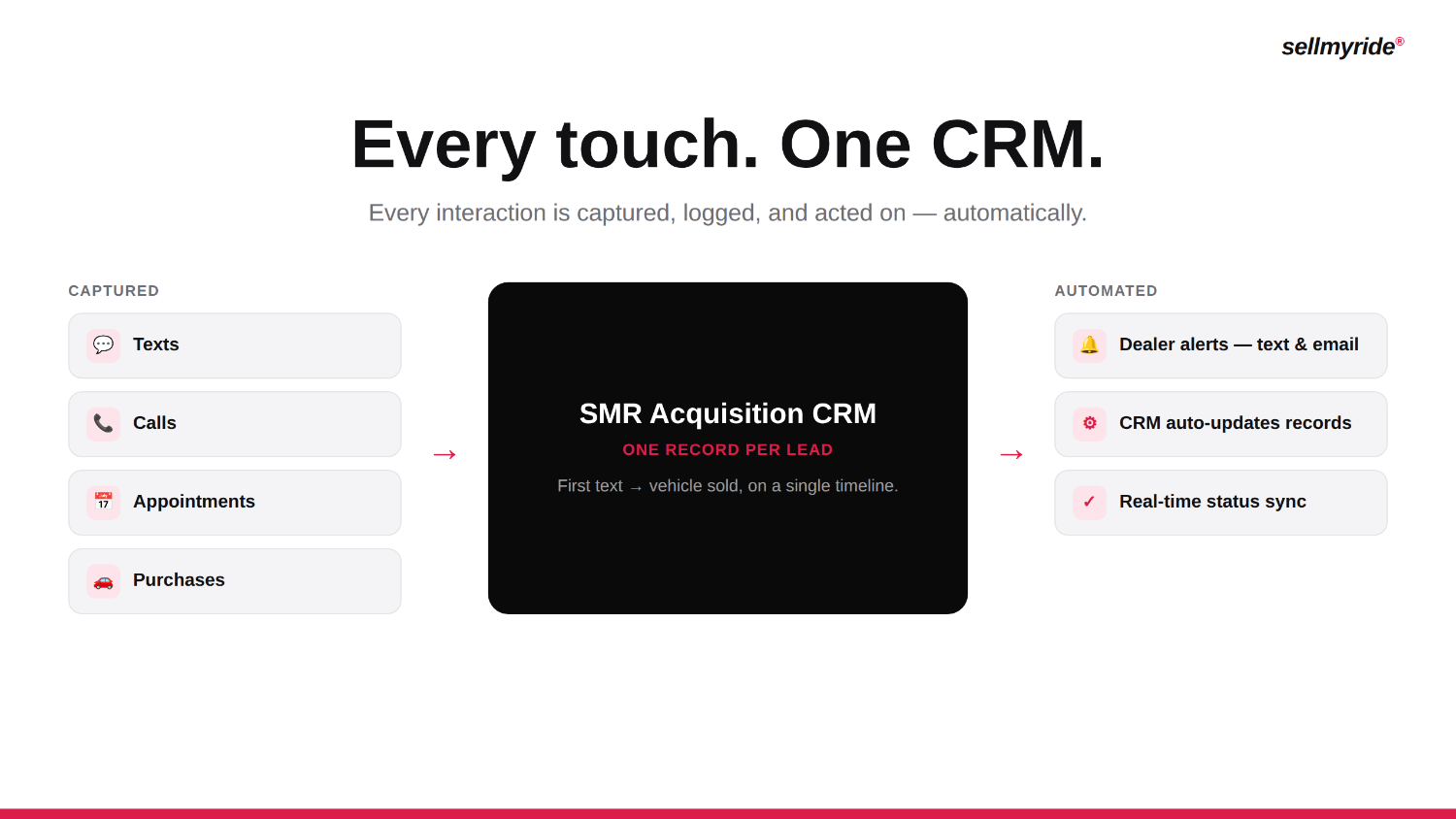
A conversational-AI acquisition agent that texts and calls every lead within 60 seconds, qualifies the vehicle, quotes a live range, books the appointment, and escalates to a human at the moment it matters. Always on, including overnight.
And underneath it
A white-label acquisition CRM as system of record across rooftops, an interactive capacity model that reframes the sale from software spend to payroll spend, and the operating model from a blank page — budget, forecasting, OKRs, KPIs, executive cadence.
Live lead → qualified → appointment booked, with no rep touching itOne record per lead · captured, logged, and acted on automatically
“The first time I've had that lightning-in-a-bottle feeling since I started AutoTrader.com.”
Chip Perry · Chairman, sellmyride · founding CEO, AutoTrader.com
78%
Margin on the acquisition engine
< 60s
First response, every lead
100%
Of leads worked, incl. overnight
2
Appointments to full payback
04Empty Shift · Co-founder
Miles: an AI agent that answers every seller lead in five seconds
Dealers buy cars from consumers by putting a value tool on their site and waiting. The lead arrives, the number is delivered, and then the follow-up depends on whether a human has the time — which overnight, on weekends, and during a busy Saturday, they do not. We built an agent that treats the number as the opening of a conversation instead of the end of one, and we built the guardrails before we built the charm.
Jordan Reyes
2019 Honda Accord EX · $18,750 – $20,250
Booked
Hi Jordan, it’s Miles at Northside Motors. Your 2019 Accord EX is worth about $18,750–$20,250 in trade. Want to bring it by for a firm offer? Reply STOP to opt out.
Miles (AI) · 9:41 PM
Miles called9:42 PM · 2:14Jordan still has a loan on the car and wants a firm offer. Booked for 1:00 PM tomorrow with Marcus.
Northside Motors: you’re booked for Sat at 1:00 PM with Marcus. Bring your title or loan statement, both keys, and your ID. Reply here to change the time.
Automatic text · 9:44 PM
Thanks. Do I need both keys?
Jordan · 9:47 PM
Yes, bring both if you have them. See you at 1:00 tomorrow.
Miles (AI) · 9:47 PM
Sending a text pauses Miles on this lead
The agent’s own loop — text, call, booking, and the follow-up question, in one thread
8
New leads
In the last 24 hours
5s
Median first response
Every lead, including overnight
3
Booked
Appraisals on today’s calendar
1
Needs you
Asked about a lease buyout
What the team opens to — booked appraisals, and the one seller who needs a person
Where the lead dies
A seller sees a trade-in value on a dealer’s site at two in the morning and, more often than not, nothing happens until someone opens the store. The number is the end of the conversation instead of the start of one — and the seller has already filled out the same form somewhere else.
What we built
Miles texts every seller within five seconds, then calls the ones who do not reply. It answers questions about the range, the payoff, and the timing, books the appraisal on a buyer’s calendar, and takes inbound calls at any hour. English and Spanish. Texts, calls, and the booking stay in one conversation the team can read.
Where it stops
Every message is checked against the dealer’s approved range before it sends; a dollar amount outside that range is rewritten, and if the rewrite also fails, the lead goes to a person. Miles never claims to be a person, says it is an AI assistant in the first line of every call, and STOP ends all contact.
See the demo0:35
The product film · a lead at 2:00 AM, booked by morning
5s
First text to every seller lead
24/7
Inbound calls answered, any hour
EN · ES
Answers a Spanish speaker in Spanish
1
Conversation per seller · texts, calls, booking
05GymRevenue · CEO & Founder
An AI-native operating system for multi-location fitness
Operators ran the business on a stack of disconnected point solutions — billing in one place, scheduling in another, member history somewhere else, and no reliable view of the enterprise. I founded the company to replace the stack with a single operating system, and led it from concept through launch and full enterprise diligence with a strategic acquirer.
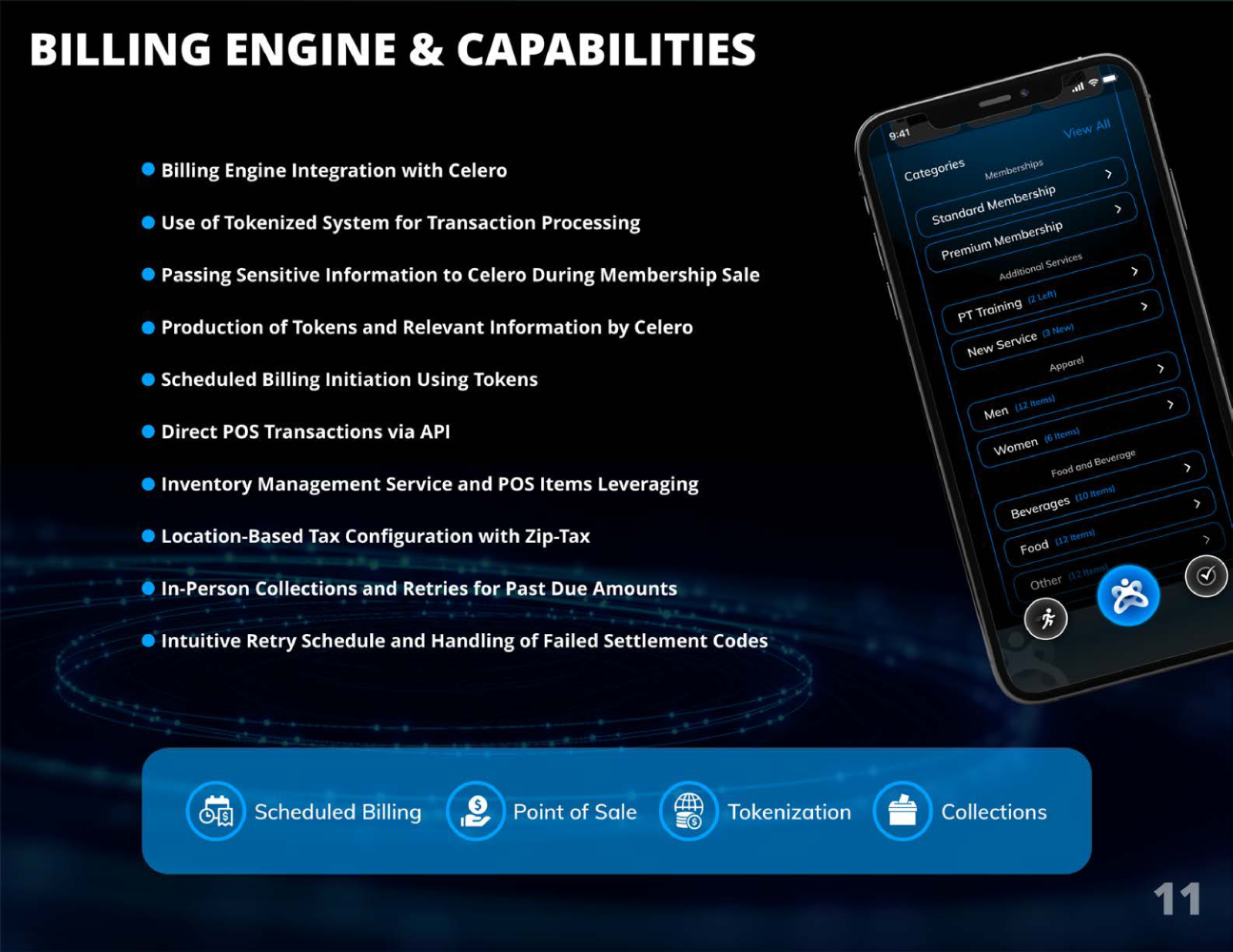
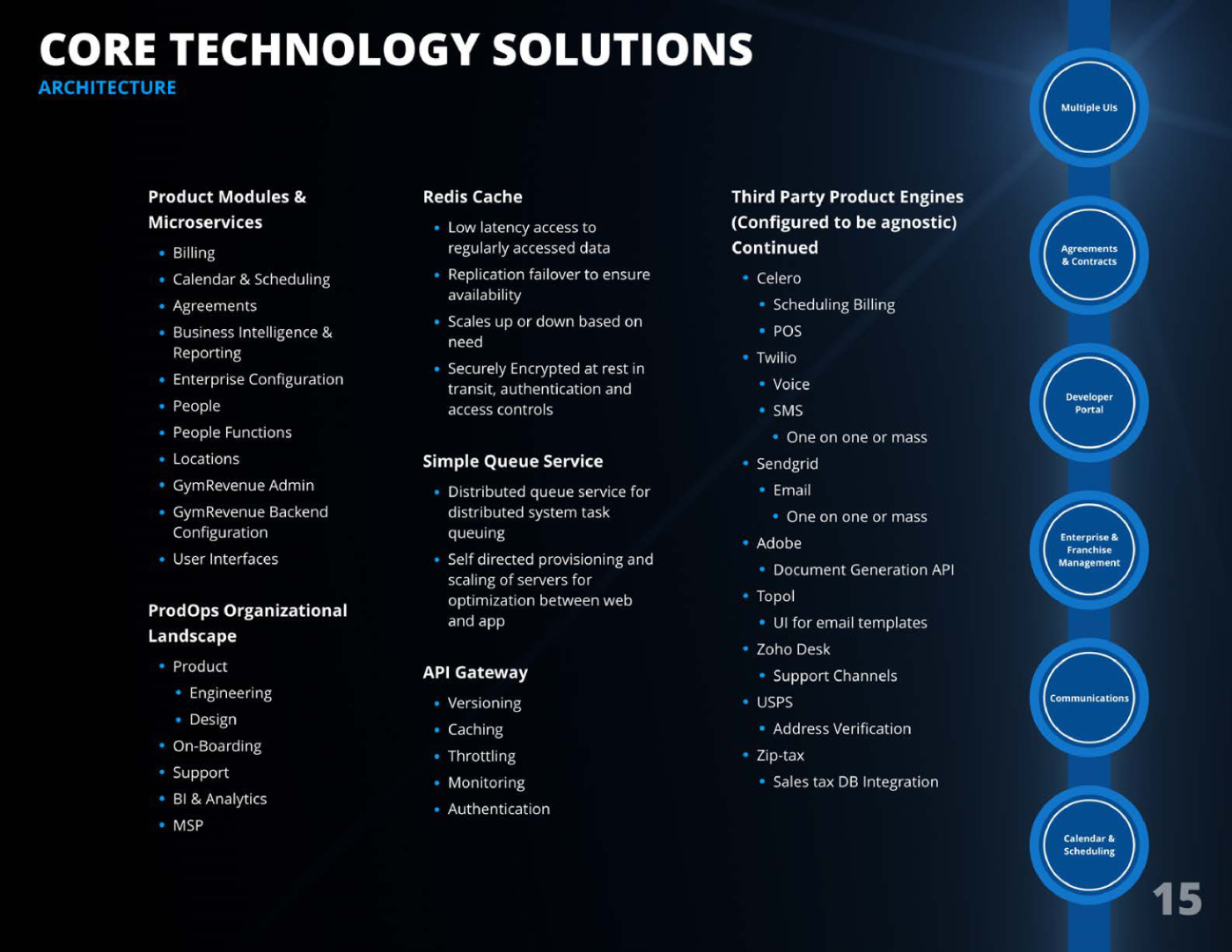
Billing engine · tokenized processing, scheduled billing, POS and collectionsProduct modules and microservices · queueing, caching, API gateway, agnostic third-party engines
Class, appointment, and resource scheduling across locations, pushed live to staff and member apps.
Agreements
Membership generation, pro-rated dues, enrollment and annual fees, e-signature at point of sale.
BI & Reporting
Live dashboards over a MySQL warehouse with a roadmap to managed cloud BI.
People & Locations
Staff, member, and multi-location configuration including franchise and enterprise hierarchies.
Retention Intelligence
Predictive analytics and automated feedback loops driving retention — not static reporting.
The system underneath
Event-sourced Laravel backend, Vue and Svelte front ends, GraphQL in place of REST, serverless AWS throughout — Lambda and Vapor, multi-AZ RDS with point-in-time recovery, Redis, SQS, CloudFront, Pusher, Capacitor for mobile. Security mapped to OWASP Top Ten, MFA with RBAC and ABAC, SIEM logging, GDPR and CCPA with DSAR handling, third-party penetration testing.
Enterprise validation
Taken through full technical and commercial diligence with a strategic acquirer — platform demo, billing and payment architecture, core stack, cloud topology and run costs, data warehouse strategy, and the complete security and privacy posture. As CEO I owned the capital story: forecasting, burn management, and board-level reporting to private-equity sponsors.
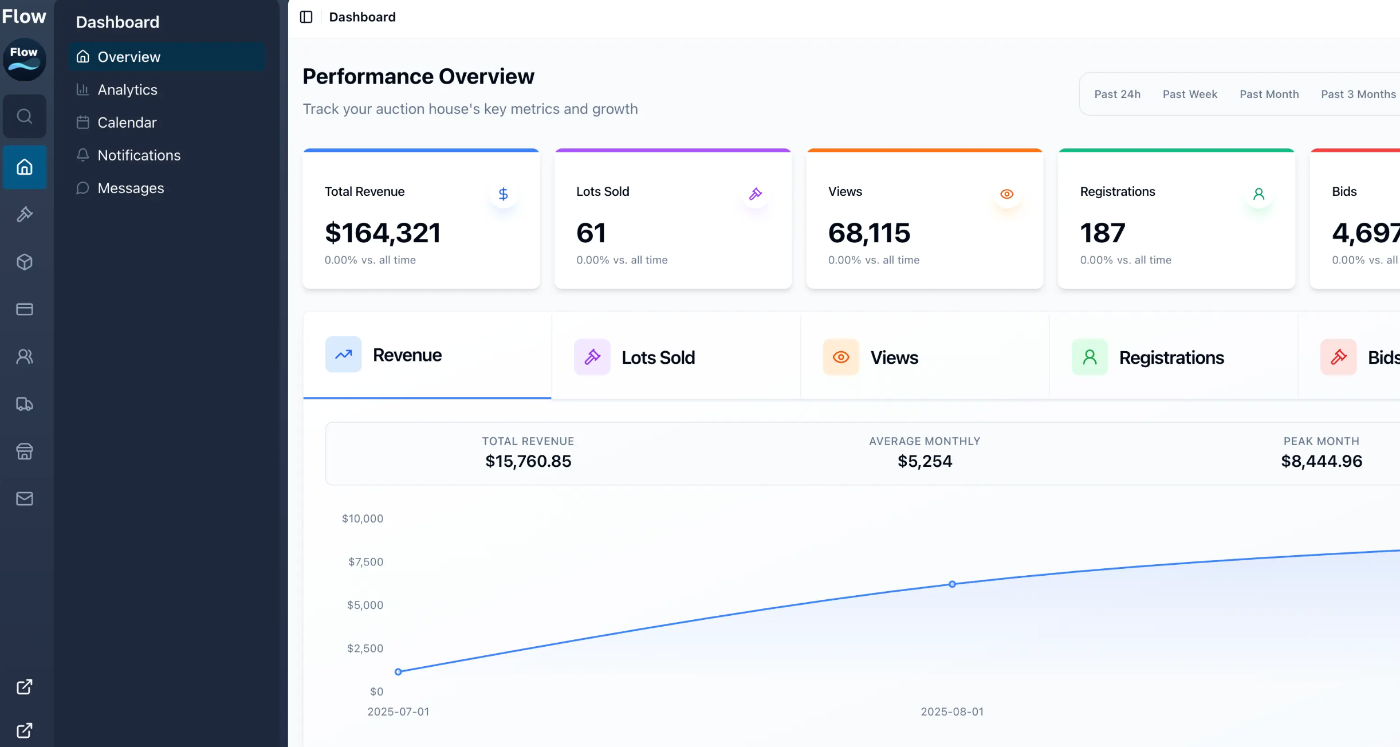
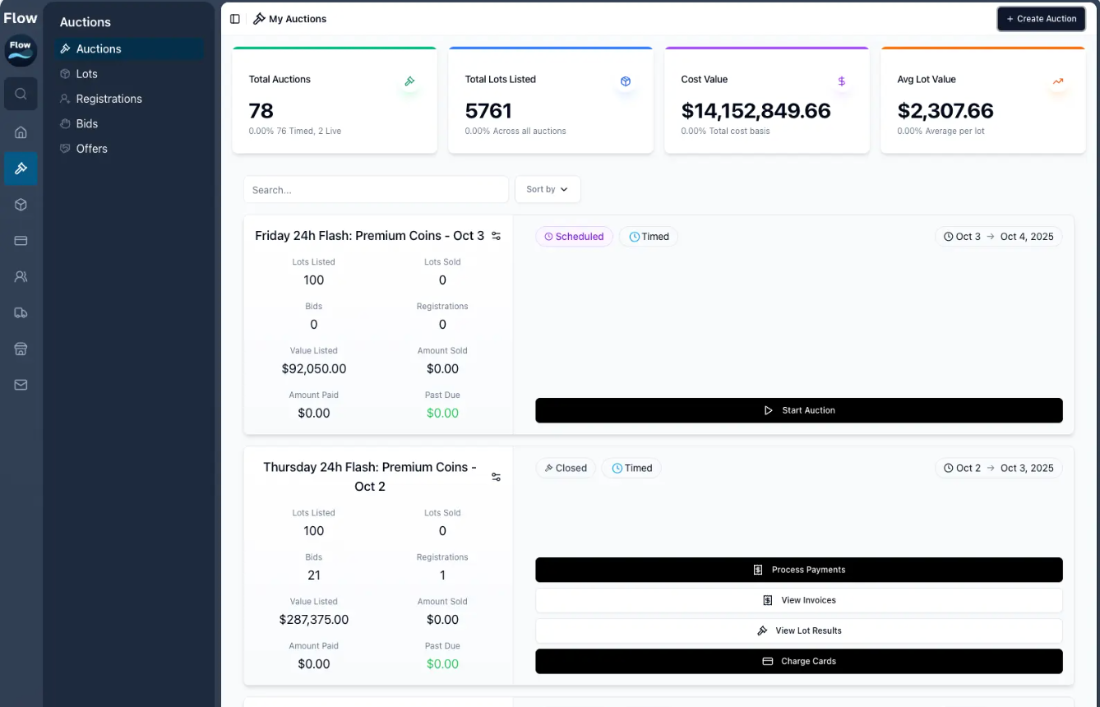
06Flow Auctions · COO & Co-founder
Three products for a trade that still ran on spreadsheets
The coin and collectibles trade moves serious money on certified inventory, and the back office behind it was browser tabs, broken formulas, and a file from 2019. We built three things against that: a marketplace where collectors bid on graded coins, a wholesale marketplace where dealers trade with each other, and the AI-native inventory system that sits underneath both and is now sold on its own. I modeled the cost of the old stack at roughly $600K a year per house and built the business case from there.
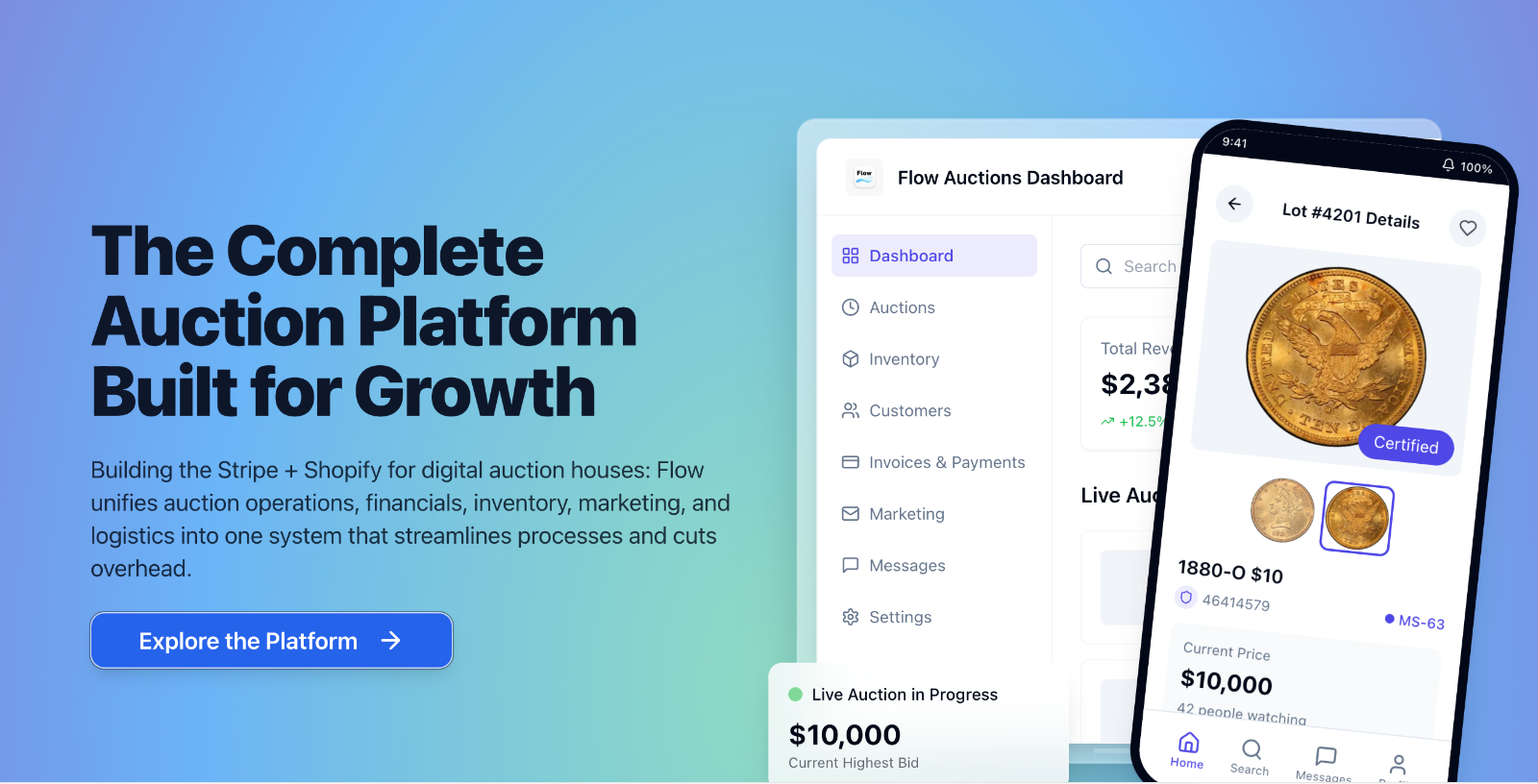
One platform · seller operations and mobile-first bidding
What the old stack costs a house, per year
Platform commissions$300K
Staff labor waste$91K
Per-lot fees$80K
Integration costs$65K
Error & rework$64K
Flow Auctions
A marketplace where collectors bid on PCGS- and NGC-graded coins in live and timed auctions, or buy at a fixed price — consigned by auction houses that keep their own bidder relationships.
Flow Dealers
A dealer-to-dealer wholesale marketplace where every listing carries a wholesale price and every buyer and seller is a verified coin shop or auction house. Offers, messages, secure payment, insured labels.
CoinManagerPro
The inventory system underneath both, now sold on its own. Bulk-scan PCGS and NGC slabs, let AI catalog each coin from the cert or a photo, price it against real auction records, and push the same catalog to eBay, HiBid, LiveAuctioneers and the dealer’s own site.
Twelve integrated products behind one login — auction management with live clerking, CRM, financials and consignor settlement, analytics, fulfillment, payments, KYC/AML identity, events, communications, inventory, compliance, and BI. Six applications from one TypeScript monorepo: seller dashboard, consumer marketplace, B2B dealer marketplace, and three React Native apps on a hybrid AWS footprint deployed as infrastructure-as-code.
What I owned
Technical operations under strict budget constraints, the P&L and financial model guiding capital allocation, and adoption run as large-scale change management across collectors, dealers, and institutions — the genuinely hard part in a category that had resisted modernization for decades. Plus delivery metrics, technical hiring standards, and board and investor communication.
15 → 1
Tools consolidated
500
Certs scanned in five minutes
4,000+
Lots a week, stress-tested
< 1ms
Bid latency
07Gold Standard Auctions · CIO
Building the data, CRM and process backbone of a company that had none
There was no data warehouse. No CRM. No business intelligence. No enterprise reporting, no FP&A function, no performance metrics of any kind — and no documented intake process or inventory system — inside a house clerking five or more auctions a week, every week of the year. Consignments arrived, lots were cataloged from memory and spreadsheets, buyers lived in inboxes, and leadership decided on instinct and lagging information. I was brought in as CIO to build all of it from nothing.
I pioneered the company's first data warehouse and CRM, its first BI layer, its first KPI and performance-metrics framework, and the operating structure and documented processes underneath them — intake, cataloging, inventory, invoicing, and settlement. With the business finally legible, leadership could see which categories, consignors, and sales actually made money and act on it inside the week. That instrumentation is what carried the company past $60M+ in ARR.
Data warehouse & BI
The first warehouse the company ever had — consignment, lot, bid, buyer, and settlement data pulled out of spreadsheets and inboxes into one modeled source of truth, with AI-ready structure and BI dashboards on top. Institutional knowledge that had lived in people’s heads became queryable.
CRM & buyer intelligence
A real CRM for consignors and buyers: one record per relationship, bidding and purchase history, segmentation, and follow-up that no longer depended on whoever happened to remember the account. Repeat-buyer behavior became something the business could measure and grow.
Intake, inventory & fulfillment process
A documented intake process and inventory system — receiving, condition, photography, cataloging, lot assignment, storage location, invoicing, and settlement — replacing tribal workarounds with steps anyone could run, at 260+ auctions a year, without dropping lots or losing days.
P&L, FP&A & the operating structure
Enterprise P&L reporting and FP&A discipline closed on a cadence: margin by sale, by category, by consignor, and cost to serve. Plus the KPI framework, executive cadence, org structure, and ICT and vendor strategy that keep the numbers honest and the systems governed.
$60M+
ARR the instrumented business reached
260+
Auctions a year instrumented (5+/week)
First
Warehouse, CRM, BI and KPI framework in company history
~15%
Operating efficiency gain
Real-time
P&L and operational visibility
08YouFit Health Clubs · Exec Director, BD & Managing Partner
21 to 150+ locations
Eight years running real multi-unit operations before ever building software for them. I joined at 21 clubs and left with the footprint past 150 across 15 states — over 500,000 members, 3,000+ employees, and $20M+ in monthly recurring revenue, grown both organically and through acquisition.
At that size the enemy is drift: 150 clubs quietly becoming 150 different businesses. My work was the operating standard that prevented it — how a club opens, sells, staffs, schedules, collects, and reports; what a manager is accountable for every week; and what the number has to look like before a new site gets approved. I ran operations planning and multi-unit budgeting against a recurring-revenue P&L, held margin and payroll ratio club by club rather than by regional average, and as managing partner carried business development for the growth of the footprint itself — including folding acquired clubs onto the same standard instead of leaving them as permanent exceptions.
This is where the operating instinct came from — and why every platform I have built since starts from how the work actually gets done in the field rather than how it looks on an architecture diagram.
$20M+
Monthly recurring revenue
500K+
Members served
3,000+
Employees across the footprint
21 → 150+
Locations, organic and acquired
Standardize the field
Large-scale organizational transformation across 150+ locations — one operating standard for business operations and service delivery, held by a distributed workforce of roughly 1,000 in-scope operators and 3,000+ employees company-wide.
Own the numbers
Operations planning, multi-unit budget management, and P&L analysis across a $20M+/month recurring-revenue portfolio — membership yield, attrition, payroll ratio, and margin performance by club rather than by region average.
Grow the footprint
Business development as managing partner — accountable for the growth of the footprint itself, organic and acquired, and for integrating acquired clubs onto the same operating standard rather than leaving them as exceptions.
What I am brought in to do
Chief Operating and Product Officer with 13+ years leading business operations and organizational design for high-growth, venture-backed, engineering-led organizations. The pattern is consistent: I am handed an unbuilt or unstructured operation and I build the thing it runs on — the product, the operating model, the governance, and the numbers that tell you whether any of it is working.
Build from a blank page
Operating model, internal systems, administrative functions, and the executive cadence that keeps a leadership team pointed at the same numbers.
Make strategy measurable
Enterprise OKR design and KPI frameworks — instituted in more than one company for the first time in its history.
Own the P&L and capital story
Forecasting, burn management, FP&A discipline, and board-level reporting to private-equity sponsors and investors.
Architect AI-native systems
Agentic workflows, predictive analytics, and automated feedback loops built into the product rather than bolted onto it.
Lead change that resists
Collectors, dealers, institutions, multi-unit field operations. Adoption is the hard part, not the software.
Run distributed delivery
Delivery metrics, technical hiring standards, and SLA-driven service models across distributed engineering and operations teams.
Instrument the operation first. I have built the first KPI and OKR framework in a company’s history more than once — because you cannot fix a business that cannot tell you which activity makes money.
02
Build the system, not the workaround
The product, the operating model, and the governance are one object. Point solutions and heroics buy a quarter; a system compounds. Fifteen tools became one platform; a disconnected stack became one operating system.
03
Adoption is the product
Software is the easy half. Dealers, collectors, institutions, and 150+ field locations change how they work only when the new way is obviously faster for them — so I run rollout as change management, not as training.
04
Own the number in the room
Forecast, burn, margin, and the board slide behind them. If I cannot defend the number to a sponsor without hedging, it is not finished.
Let's get in touch
Happy to walk through any of these in detail — the decisions behind them, the constraints they were built under, and the parts that did not work and what I changed because of them.